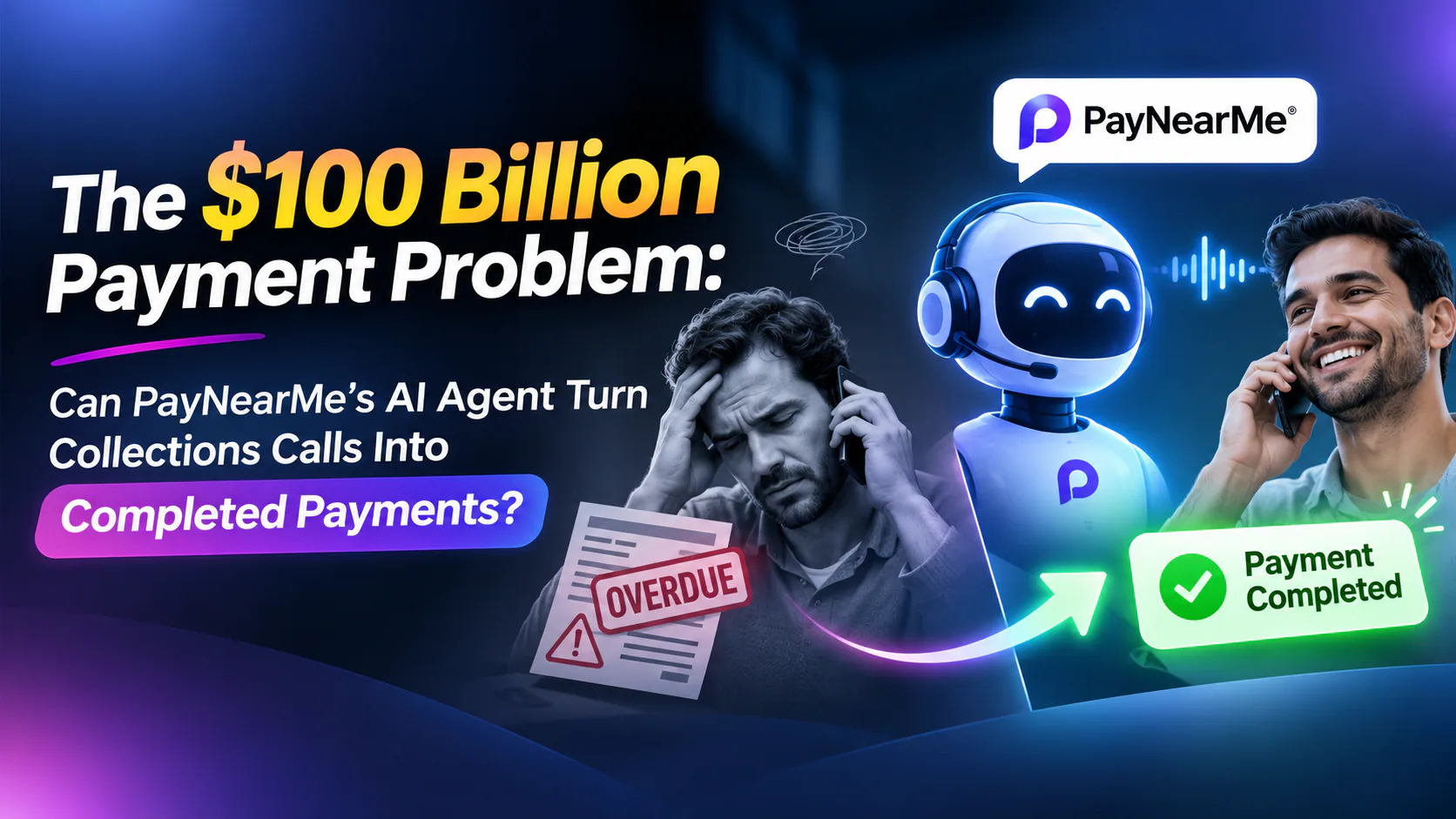
PayNearMe’s AI Servicing and Collections Agent can match the hourly calling output of approximately 28 support staff members. But the bigger opportunity is hidden in the economics of payment friction.
A customer intends to pay. The payment fails. They call customer support. Someone checks the account, explains the issue, sends a payment link and waits for the customer to complete the transaction. If the customer does not, another reminder may follow. Another call may be required. Another employee gets involved.
The payment itself may be worth hundreds of dollars. Yet the effort required to get it completed can involve multiple people, systems and interactions.
This is the uncomfortable economics of payment servicing: financial institutions do not just pay to process transactions. They pay for everything that goes wrong, gets delayed or requires human intervention before a transaction is completed.
TransUnion's 2024 survey highlights the industry's shift towards digital collections: 88% of surveyed collection companies used self-service payment portals, up from 79% in 2023, while 52% were investing in technology to improve productivity and margins. Additionally, 48% planned to adopt text messaging and chatbots. However, data security remains a growing concern, with 48% of respondents highlighting it as a challenge.
PayNearMe's Payment Experience Gap report estimates that a representative mid-size lender incurs approximately $7.22 in total cost for every payment accepted. Only $1.20 of that estimate comes from transaction fees. The remaining $6.02 comes from customer experience, support and operational costs.
Now put that into perspective. PayNearMe estimates that an enterprise processing 500,000 payments annually could incur approximately $3 million in payment-related costs under its model. Against this backdrop, the company's October 1, 2026 launch of its AI Servicing and Collections Agent becomes more than another fintech automation announcement.
During a pilot with Indiana Finance Company, PayNearMe reported that its AI agent placed as many calls in one hour as approximately 28 support staff members would typically place during the same period. That is a compelling productivity signal. But the real question is not how many calls AI can make.
Can an AI agent reduce the distance between a customer intending to pay and a payment actually being completed?
That is where the future of AI-powered debt collection becomes interesting. And it is where the economics of agentic AI in financial services deserve much closer attention.
The $7.22 problem: Processing a payment is only part of getting paid
Most financial institutions know what they pay their payment processors. Transaction fees are visible, reported and relatively easy to benchmark. The less visible expenses are often scattered across customer support, operations, failed-payment recovery and payment servicing. PayNearMe's Payment Experience Gap report attempts to quantify those expenses for a representative mid-size lender. Its estimated cost breakdown is:
Cost category | Estimated cost per payment | What it includes |
Transaction fees | $1.20 | Payment processing |
Customer experience | $1.31 | Delayed or incomplete payments and associated friction |
Customer support | $2.70 | Assisted payment completion, troubleshooting and enquiries |
Operations | $2.01 | Returns, recovery, disputes and back-office work |
Total | $7.22 | Estimated total cost of payment acceptance |
The most striking finding is the gap between the cost financial institutions commonly measure and the cost they may actually incur. For every $1.20 spent on transaction fees, the model identifies another $6.02 in costs associated with getting the payment completed. That means transaction fees account for only a fraction of the modeled cost of payment acceptance.
The $2.70 support component is particularly relevant to AI adoption. PayNearMe's model uses an approximately 20% payment-related interaction rate and a blended assisted-support cost of approximately $13.50 per contact to estimate the support expense. In other words, the cost of helping customers complete payments can become a substantial part of the payment economics.
However, there is an important boundary to this analysis. PayNearMe's report focuses on payment acceptance, payment friction and early-stage recovery activity. It explicitly excludes downstream collections and costs associated with severe delinquency.
Therefore, the $7.22 figure should not be presented as the cost of debt collection, and it should not be treated as the amount an AI collections agent can automatically save.
Its value is different: it reveals how much operational expense can sit outside the transaction fee that financial institutions typically monitor. The opportunity is to stop looking at payment processing as a transaction and start measuring it as an end-to-end customer journey.
The 28-person benchmark: What PayNearMe's AI agent actually demonstrated
On October 1, 2026, PayNearMe introduced its AI Servicing and Collections Agent, built directly into its PayXM platform. The agent combines conversational AI with payment data, business rules and workflows. It is designed to support inbound self-service and proactive outbound engagement.
Its reported capabilities include:
Calling and texting customers about upcoming, due and past-due payments.
Answering inbound calls and addressing account-related questions.
Helping customers make or schedule payments.
Capturing promises to pay.
Sending payment links through PayNearMe Smart Links.
Handling opt-out requests.
Transferring interactions to human support when necessary.
The most notable result came from a pilot campaign with Indiana Finance Company.
PayNearMe reported two key outcomes:
Approximately 28 support staff: The agent placed as many calls in one hour as approximately 28 support staff members would typically place during that period.
90% of targeted accounts: Accounts received at least one of the following outcomes: a voicemail or Smart Link, a completed live conversation, or a transfer to support staff.
These figures point towards a meaningful opportunity to expand customer outreach without increasing manual calling capacity at the same rate. But there is a distinction financial institutions should not overlook.
The 28-person comparison measures calling volume, not 28 times the overall productivity or 28 times the recovery rate. The 90% figure measures specified contact or interaction outcomes, not the percentage of customers who paid. It does not establish that 90% of overdue balances were recovered, that delinquency fell by 90%, or that the agent achieved a particular return on investment.
That is precisely why the next phase of AI adoption needs better measurement. The important question is whether additional outreach creates additional successful payment outcomes, and whether those outcomes justify the cost of deploying and operating the technology.
Where agentic AI in financial services could deliver the greatest value
Not every collection interaction needs an autonomous agent. The strongest starting point is usually a workflow that is frequent, repeatable, rules-based and measurable. For lenders and payment providers, potential use cases include:
Payment reminders: Proactive outreach for upcoming, due and past-due payments.
Failed-payment assistance: Helping customers understand a failed payment and access the appropriate next step.
Payment scheduling: Supporting customers who need to arrange a payment for a later date.
Account enquiries: Answering routine questions using verified account information.
Promise-to-pay capture: Recording a customer's stated intention to pay and making the relevant information available to the servicing workflow.
Digital payment assistance: Sending a payment link and helping customers move from a conversation to a digital payment.
Human escalation: Identifying disputes, hardship situations, complaints and other cases that require trained support staff.
A sensible deployment strategy is to start with one or two high-volume workflows, establish a performance baseline and expand only after the results are validated. This avoids a common mistake in enterprise AI: automating an entire process before understanding which parts are actually suitable for automation.
The compliance question: Can collections AI scale without creating new risks?
Collections is a sensitive financial-services activity. A more efficient system is not necessarily a better system if it creates confusion, inappropriate contact or inaccurate information. For US debt collection, the Consumer Financial Protection Bureau's Regulation F provides important guidance on communications.
The CFPB explains that debt-collection communications can include telephone calls, text messages, emails and other electronic channels. It also addresses restrictions on communication frequency, inconvenient contact and consumer requests to stop using specific communication methods.
For example, an automatically generated text message is not exempt from the rules simply because it is automated. Electronic communications also have opt-out requirements in applicable circumstances.
This has direct implications for any organisation deploying AI-powered debt collection. An agent needs to respect contact preferences, apply appropriate communication rules, protect sensitive information and provide a clear path to human assistance.
A responsible deployment should include:
Identity verification before disclosing account information.
Approved scripts, policies and business rules for sensitive interactions.
Accurate account and payment information from trusted systems.
Clear permissions for accepting or scheduling payments.
Records of conversations and actions taken.
Appropriate handling of disputes and financial-hardship situations.
Human escalation for interactions that require judgement.
Controls for communication consent, opt-outs and applicable regulatory requirements.
Regulatory requirements vary by jurisdiction and by the type of creditor or debt collector. Financial institutions should obtain appropriate legal and compliance review before deployment. The principle is straightforward: automation should increase operational capacity, not reduce accountability.
What PayNearMe's AI roadmap signals about the next phase of fintech
The October 2026 launch builds on PayNearMe's earlier AI work. In October 2025, the company introduced its AI-powered Intelligent Virtual Agent. The newer Servicing and Collections Agent extends that foundation into proactive outbound engagement and payment-related actions.
PayNearMe also announced its acquisition of Marr Labs' technology assets in September 2026, adding to its broader AI capabilities. Together, these developments suggest a strategic direction: embedding AI within payment infrastructure and servicing workflows rather than treating it as a separate chatbot layer.
This is an important distinction for fintech. A conversational interface can help a customer understand what to do. A connected agent can potentially help the customer complete the task. The same principle could extend to other financial-services workflows, including billing enquiries, account servicing, payment exceptions and routine customer support.
At the Finov AI Summit, this is the kind of strategic shift worth examining: how financial institutions can move beyond AI pilots and connect intelligent automation to measurable business performance.
The next phase of agentic AI in financial services will require more than sophisticated language models. It will require secure data access, integration with core systems, clearly defined permissions and a measurement framework that connects automation to financial outcomes.
PayNearMe's announcement provides a practical example of that direction. Whether its model delivers sustained improvements in recovery rates, customer experience and cost per successful collection will require further performance evidence.
Five questions every lender should ask before deploying an AI collections agent
Before moving from a pilot to a wider rollout, decision-makers should be able to answer five questions.
1. What percentage of our collections workload is genuinely repetitive?
Identify routine reminders, basic payment enquiries and standard payment scheduling before selecting workflows for automation.
2. Can the AI agent access reliable payment and account information?
An agent without accurate context can create more work than it removes.
3. Which actions can it take without human approval?
Define permissions for account enquiries, payment scheduling, payment acceptance and other sensitive actions.
4. Are we measuring completed payments or just automated interactions?
A campaign's success should be tied to payment conversion, kept promises and cost per successful collection.
5. Can customers reach a human when they need one?
The ability to escalate is essential for disputes, hardship, complaints and situations that require human judgement.
If these questions cannot be answered, increasing automation volume is premature.
Conclusion: The future of collections will be measured in outcomes, not conversations
PayNearMe's 28-person calling comparison is a powerful indication of how AI can expand operational reach.
Its 90% account-contact or interaction result shows the potential to engage a large share of targeted accounts through a combination of voicemail or Smart Links, live conversations and support transfers. Its Payment Experience Gap report adds another layer to the discussion, estimating $7.22 in total payment acceptance costs per payment for a representative mid-size lender.
Together, these findings point to a much bigger opportunity: reducing the friction and manual effort that sit between a customer's payment intention and successful completion.
But the evidence should not be stretched. The pilot does not yet establish a 28-fold productivity improvement across all collections activities, a 90% recovery rate or a proven reduction in cost per successful collection. The $7.22 payment acceptance model also does not measure downstream collections and severe delinquency costs.
Those are the outcomes financial institutions must measure next. The real competitive advantage will not belong to the organisation with the most AI agents or the highest automated call volume. It will belong to the organisation that connects customer intent, accurate financial information and controlled execution in a way that makes payments easier to complete. Because in collections, a conversation is only the beginning. The business outcome is the payment that follows.
Frequently asked questions
What is PayNearMe's AI Servicing and Collections Agent?
An AI agent PayNearMe launched on 1 October 2026, built into its PayXM platform. It calls and texts customers about upcoming, due and past-due payments, answers inbound account questions, helps customers make or schedule payments, captures promises to pay, sends payment links through PayNearMe Smart Links, handles opt-out requests and transfers conversations to human support when needed.
What did the pilot with Indiana Finance Company show?
PayNearMe reported that the agent placed as many calls in one hour as about 28 support staff would typically place in that time, and that 90% of targeted accounts received at least one outcome: a voicemail or Smart Link, a completed live conversation, or a transfer to support staff.
These figures measure calling volume and contact outcomes. They don't show a 90% recovery rate, a 28-fold productivity gain or a particular return on investment.
How much does it cost a lender to accept a payment?
PayNearMe's Payment Experience Gap report estimates about $7.22 per accepted payment for a representative mid-size lender: $1.20 in transaction fees, $1.31 in customer experience, $2.70 in customer support and $2.01 in operations. The report excludes downstream collections and severe delinquency, so $7.22 is not the cost of debt collection, nor the amount an AI agent would save.
Which collections tasks suit an AI agent best?
Work that is frequent, repeatable, rules-based and measurable: payment reminders, help after a failed payment, payment scheduling, routine account enquiries, capturing promises to pay and sending payment links. Disputes, hardship cases and complaints should go to trained staff. A sensible start is one or two high-volume workflows with a performance baseline, expanding only once the results are validated.
What rules apply to AI debt-collection calls and texts in the US?
The Consumer Financial Protection Bureau's Regulation F covers debt-collection communications, including calls, texts and emails. It restricts how often and when collectors make contact and lets consumers stop specific channels, and an automated text is not exempt just because it is automated. A responsible deployment needs identity verification, approved scripts, accurate account data, records of conversations, opt-out controls and human escalation, with legal and compliance review before launch.
How should lenders measure whether an AI collections agent works?
By completed payments rather than automated interactions: payment conversion, kept promises and cost per successful collection. Extra outreach only matters if it leads to more successful payments that justify the cost of deploying and running the agent.